Posts

What the Romans did for you!
Image
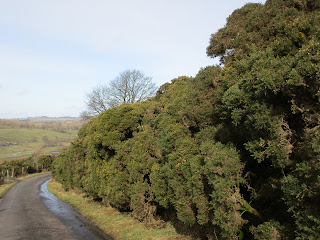
Whilst walking our local lanes I became fascinated by the slowly emerging plants  peering through the cold February soil.   The foxglove (Digitalis purperea) is suddenly evident as is the Greater celandine (Chelidonum majus).  The Gorse (Ulex europaeus) is springing to life too.  The bright yellow pea shaped flower is beginning to stand out against spikey, evergreen leaves.  The Gorse is the only native to the United Kingdom.   As I wander the lanes this week I think about all the plants that have been introduced. The topography of this country has been greatly affected by imported plants, trees, animals and insects.   Foxgloves emerging from the damp winter soil The Babylonians were famous for their hanging gardens; the Egyptians had gardens as a courtyard with the house built around the edge;  the Greeks introduced public parks and roof gardening in clay pots.    The Greeks grew roses and the ancient Egyptians offered the ros...

Paradise Gardening

Image
The first secular reference to Gardening is from the Assyrians in about 3000 BC.   Hunting parks were stocked with wild beasts for the sport of Kings and planted with every known tree.   The Persians who over-ran Assyria were dazzled and delighted by these Parks and made their own wherever they settled.   Called Pardes (Persian for Park).    Later Pardes was translated into Greek and became Paradise.    Eventually the idea spread into Europe. In Cumbria we have a paradise of our own in Grasmere. "The bosom of the mountains, spreading here into a broad basin, discover in the midst of Grasmere water, its margin is hollowed into small bays with imminences, some of rock, some of turf, that half conceal and vary the figure of the little lake they command a little unsuspected paradise ". Thomas Gray (1716-1771)   Grasmere overlooked by Loughrigg Fell - an unsuspected paradise Another story, with Cumbrian links, of a paradise was composed...

Gardening in Eden the natural way

Image
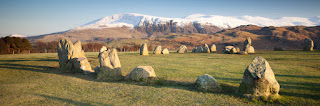
England's second largest county, with a population of less than 500,000, is Cumbria.    Here there are displays of every example of garden style and design. Protected by the North Pennines to the East, the Irish Sea to the West and the Lakeland Fells, the counties rural isolation has prevented fashion from dictating gardening trends.   Change for changes sake has never been a priority to the native of Cumbria. The landscape dominates.     Naturalistic planting overrides every horizon, puts a mark on the whole terrain.    The results are spectacular.   Castle Rigg Stone Circle, just East of the town of Keswick, is my favourite Cumbrian landscape.    Created by nature, manipulated by man.   Erected in approximately 3000 BC Castle Rigg is potentially one of the earliest henge monuments in England and was taken into guardianship in 1883.    There are more than 300 stone circles in England, over fifty of the...

The Pest Control Army

Image
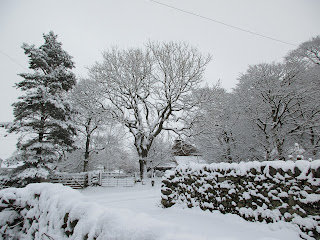
Yesterday sunshine, today the snow falls.    I tramp through the blizzard to feed my pest control army -  the birds that inhabit our garden.    Last weekend (29th -31st January 2021) the Royal Society for the Protection of Birds  (RSPB)  held the British Big Garden Birdwatch.    This information has helped increase the understanding of the challenges faced by the nation's wildlife.   Over the past 40 years data has been collected, collated and analysed.      Results have helped identify problems and contributed towards correcting setbacks.  In one of the first surveys the decline of the song thrush in gardens was identified    In 1979 the thrush was the tenth most popular bird in our gardens in 2019 the tuneful thrush was number 20, numbers had declined by 76%.            Birds are not only beautiful but beneficial to the garden too.   They bounce on electricity ...
Image
Snowdrops - the symbol of hope  The soil is sleeping now.    There is a surge of activity to come.   The first snowdrops are poking their tiny buds above the sodden earth as if to enquire whether it is safe to emerge. The white bell shaped flowers, with smooth dull, green narrow leaves, are the first sign that spring is on the way.    The snowdrop does not have petals but instead has six white flower segments, known as tepals.    There are two structures three outer, convex in shape, and three inner, that are shorter, and have a small green notch at the top. Snowdrops do not rely on pollinators to reproduce but will usually be visited by bees and other insects on a warm day. Part of the national collection for snowdrops is held in Carlisle, Cumbria.    Margaret and David MacLennan have more than 1500 species in their nursery, including species and named varieties. The scientific name for snowdrops is Galanthus - it means milk flower...

The Trees that Monkies Puzzle Over?

Image
Like a giant elephant's foot the massive Araucaria araucana sits proud in a Pinetum just 4 miles from my home.    The vicinity, alongside Aira Beck, was landscaped by the Howard family of Greystoke in the 1780's and is close to the shores of Ullswater, the Lake District National Park's second longest body of water. The area, used as a pleasure garden, contains footpaths, tracks and bridges.   Over half a million native and ornamental trees surround easily accessible waterfalls - the Cascades, High Force and Aira Force. In 1846 the Howards created a tree garden below Aira Force when they planted over two hundred specimen conifers (firs, larches, yews, pines, spruces and cedars) from all over the world.    This was the age of Victorian exploration and Empire, collectors were travelling the world discovering new plants to set into the landscapes of Great Britain. Cone bearing trees are easily distinguished from other woody plants.   None more so than...

Spots of Time

Image
  Dove Cottage, Grasmere, Cumbria "When I undrew my curtains in the morning, I was much affected by the beauty of the prospect and the change.    The sun shone, the wind had passed away, the hills looked chearful."    Friday, 16th April 1802.     Dorothy Wordsworth (1717-1855) Today snow is falling.   Once more our fell is covered in white powder.     Dorothy Wordsworth sister of Romantic poet William Wordsworth (1770-1850) wrote regularly in her journal.   Through her diaries we possess a social history of Dorothy's life and times. Dorothy and William moved into Dove Cottage, Grasmere, in 1799. "D is much pleased with the house and appurtenances the orchard especially;   in imagination she has already built a seat with a summer shed on the highest platform in this our little domestic slip of mountain"     December 1799   Letter to Samuel Taylor Coleridge (1772-1834) I visualise...

Garden Ghosts

Image
Strolling the gardens of Lowther Castle you may come across the ghosts of those who have walked before.   Since 1150, through thick and thin, the Lowther family has ruled the North of Cumbria, their wealth accumulated through the development of coal.    Phantom spirits flourish throughout their vast estate.   Sir John Lowther (1605-1675) - the first Viscount, formally laid out the gardens, fathered 10 children by his first marriage and four by a second marriage William Wordsworth (1770-1850) - English poet.   The Lowther estate owed his family £5000 in legal fees and outstanding wages  Sir James Lowther (1736-1802) - Earl of Lonsdale, known locally as "Wicked Jimmy", a skinflint with a natural flare for political skulduggery  JMW Turner (1775-1851) - outstanding Romantic painter whose Lowther Sketchbook can be viewed in Tate Britain, London Robert Smirke (1781-1867) - leading architect of the Greek Revival style - he began work on the designs...

Coal Mining in Cumbria

Image
Thick snow clads the fells, the blue sky has turned to pink.    Our garden, our road has been covered in snow for two days.    Early this morning the temperature was minus 8 degrees centigrade. We stay at home, logs burn in the stove, inside the cottage the air is warm.   All is quiet, peaceful only chattering of birds disturb the calm. Yesterday in the morning, a short period of excitement.    A van stalled on the hill outside our garden -  a Border TV motor vehicle was stuck in the snow. The ITV  TV team had arrived to interview our neighbour-Amy Bray. She lives another mile along the lane.    The crew do not make it past our house. After strolling up and down the hill the ITV team are rescued by the Bray family. They arrive with spades and a wheelbarrow, they s pread salt and grit, call farming friends.  An hour passes before two tractors appear to shunt the van up the hill, turn it around. The crew decide t...

Ten lords a-leaping

Image
  On the twelfth day of Christmas I wander through my garden.   My mind's eye sees the images of Kate Greenaway's fairies.    I search for the Elf Ring.    Are there " Ten lords a-leaping" ?    I count the number of elves in the illustration.  How many  f airies dance on toadstools.    I make a wish - to discover fairies in my garden. I look under under leaf debris.   Are they concealed behind rocks?   Buried in the snow?  The birds chirp.    Suddenly the tweets, the chirrups reach a crescendo.    Do birds see fairies?  We have many birds in our garden but none louder than the sparrows.   I estimate more than thirty.   They live amongst the evergreen shrubs that clad the front of the house.  The spiny shoots of Berberis thunbergii are the perfect foil for sparrows, for fairies, and for elves. During the 19th Century the Victorians revered fantasy, r...