Posts

The Landscape Movement

Image
At the beginning of the 18th Century (1705) the Brompton Nursery, in the centre of London, valued its entire stock of clipped evergreen trees and shrubs at £40,000.    The plants were sold at 1 penny per plant so they probably had more the 9,600,000 plants.     The demand for topiary was huge, but soon to become unfashionable when the change to landscape gardens took place.   The landscape garden movement was greatly influenced by two men William Kent (1685-1748), in the first quarter of the 18th Century, and Lancelot (Capability) Brown (1716-1782) in the second half of the century. The Enclosures Acts from 1830, when common land was enclosed in walled or hedged fields, changed the face of the landscape. The large houses developed country parks with the help of the Ha Ha - a walled bank made by cutting the ground away to form a large sunken area.   Taking the place of a fence the Ha Ha could not be seen from the house and had the effect of jo...
Exploring Dacre and Dalemain Historic Gardens

Image
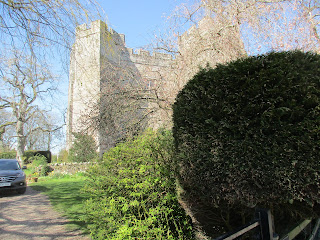
Thursday was a perfect day for a walk from the tiny village of Dacre to Dalemain Mansion and the historic gardens.    We set off past St. Andrew's church, the Dacre Clock Company offices and Dacre Castle.  The views were stunning, the North Pennines, the Lakeland fells and lush verdant fields.   Newly born lambs accompanied us. We sat outside the ancient barn drinking coffee accompanied by marmalade ginger bread cake.   Dalemain is internationally famous for the annual marmalade festival.   No one else was around.   Peaceful and tranquil.    Trees were literally bursting into leaf as we sat.   The gardens are magical.    No need for words.    Dacre Castle   Dalemain's Elizabethan Cobbled Courtyard The Elizabethan Parterre The Spiral Garden Views of the North Pennines The Rose Walk The Top Garden - exciting new developments Ribes sanguineum 'Album' We finished the day in Dacre.  ...

Exploring the Great Gardens of Cumbria from 1485-1603

Image
As the Spring sunshine at last unfolds the bare bones of gardens display their structure to the  dedicated horticulturist.    This time is ideal for the enthusiastic gardener to visit gardens open to the public.      April's cold weather has put on a great show of daffodils and primulas too. Many beautiful gardens open to the public during April.   Several in Cumbria have their foundations in the reign of the Tudor (1485-1603) and Stuart Kings(1603-1714).   Dalemain Mansion , near Penrith, was purchased in 1679 by Sir Edward Hassell (1642-1717).   He was  secretarie and chiefe officer  Lady Anne Clifford (1590-1676), the last member of one of England's great medieval dynasties who became a legend in her own lifetime she fought a 40 year battle for the right to inherit her father's estates then devoted herself to restoring and enhancing castles and churches on her land.   Her castles were in both Cumbri...

The best places to see Daffodils in Cumbria

Image
The past week of sunshine has been a week of high activity for gardeners.    Pruning, dividing plants and mulching while the ground is still cold but dry.   Today the air is crystal clear, the sky is blue but the temperature has dropped to minus 3 degrees Centigrade.      Daffodils line the gravel path in my garden At this time of year, with trees naked of leaves, grand vistas continue to unfold throughout the region.    The daffodils are dancing in the breeze, gay and everchanging.    We have so many beautiful spots to view daffodils in Cumbria, one of the most famous is Dora's Field, named for the daughter of William Wordsworth (1770-1850).   The field is tucked behind St. Mary's Church, Rydal, at the foot of Rydal Mount, the poet's home from 1813 until his death, at the age of 80, in 1850.   Dora's Field was where William Wordsworth planned to build a house for his daughter instead, after her early death, he p...

Savour the coming of Spring and celebrate!

Image
We have moved into the light with the Spring Equinox tilting the equilibrium in our favour.    Also, known as the vernal equinox, the Spring Equinox marks the date when light and dark last the same amount of time.   The Sun is certain to stay in the sky longer and longer until June's Summer Solstice.    Relish it!   The Arrival of Spring - Holehird Gardens, Windermere, overlooking the Langdale Pikes After the reign of the Norman Kings came the Tudors (1485-1603) and then the Stuarts (1603 - 1714).  A luminosity  came to Britain's gardens.   Similar to that of the coming of Spring. The formidable Brougham Castle, Penrith, founded in the early 13th Century as a barrier against Scots invaders, became a prestigious residence.   Beside the crossing (ford later a bridge) of the River Eamont, in a picturesque setting, the Castle became one of the many homes of Lady Anne Clifford (1590-1676).  Lady Anne was probably the great...

Asset Stripping in the 16th and 21st Century

Image
Assets marked with stickers are new to me.   Did Thomas Cromwell mark the assets of  abbeys, monasteries and convents when from 1536 to 1541 they were acquired by King Henry VIII (1509-1547).   The monasteries were a reminder of the power of the Catholic Church.    By destroying the monastic system King Henry VIII would acquire wealth and property whilst removing the church's Papist influence. Since September 2020 I have been studying two horticultural courses at Newton Rigg College, Penrith.    Classes, recently suspended, began again last Monday.    On our return we discovered bar coded stickers on practically every item of equipment and furniture.    The college is to be sold soon.    Our community is anxious. Religious buildings and places of education are of prime importance.   Cumbria's infrastructure was seriously challenged when the many monastic buildings and gardens were destroyed.  ...

Hard landscaping in the time of the Norman Kings

Image
Many dry stone walls within the Lake District were erected by way of clearing the land for cultivation.    Some walls were constructed in the 18th and 19th Century but a great number date back to the time of the Norman kings of England (1066 - 1485) William of Normandy slowly changed the landscape of England after winning the fight for the throne in 1066.   Walls built without the use of mortar were part of that change.   As were Castles, fortified towers, religious structures and Royal Hunting Forests.    A dry stone wall collapsed in my garden a few days ago.    Width x 80 cm (2.5 feet) Height x 140 cm  (4.5 feet).    This exceptionally wide wall has left a large scar.    The winter's weather - frost, snow wind, rain and now sunshine - has taken its toll. Stone walls dominate the landscape of Cumbria.   They also reflect the geology of the area.  Many buildings, also, are constructed with rock ex...

What the Romans did for you!

Image
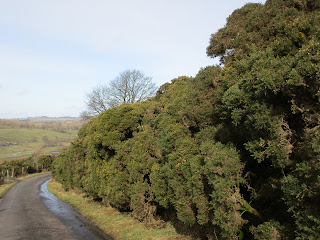
Whilst walking our local lanes I became fascinated by the slowly emerging plants  peering through the cold February soil.   The foxglove (Digitalis purperea) is suddenly evident as is the Greater celandine (Chelidonum majus).  The Gorse (Ulex europaeus) is springing to life too.  The bright yellow pea shaped flower is beginning to stand out against spikey, evergreen leaves.  The Gorse is the only native to the United Kingdom.   As I wander the lanes this week I think about all the plants that have been introduced. The topography of this country has been greatly affected by imported plants, trees, animals and insects.   Foxgloves emerging from the damp winter soil The Babylonians were famous for their hanging gardens; the Egyptians had gardens as a courtyard with the house built around the edge;  the Greeks introduced public parks and roof gardening in clay pots.    The Greeks grew roses and the ancient Egyptians offered the ros...

Paradise Gardening

Image
The first secular reference to Gardening is from the Assyrians in about 3000 BC.   Hunting parks were stocked with wild beasts for the sport of Kings and planted with every known tree.   The Persians who over-ran Assyria were dazzled and delighted by these Parks and made their own wherever they settled.   Called Pardes (Persian for Park).    Later Pardes was translated into Greek and became Paradise.    Eventually the idea spread into Europe. In Cumbria we have a paradise of our own in Grasmere. "The bosom of the mountains, spreading here into a broad basin, discover in the midst of Grasmere water, its margin is hollowed into small bays with imminences, some of rock, some of turf, that half conceal and vary the figure of the little lake they command a little unsuspected paradise ". Thomas Gray (1716-1771)   Grasmere overlooked by Loughrigg Fell - an unsuspected paradise Another story, with Cumbrian links, of a paradise was composed...

Gardening in Eden the natural way

Image
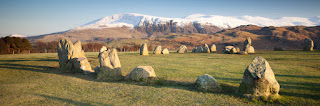
England's second largest county, with a population of less than 500,000, is Cumbria.    Here there are displays of every example of garden style and design. Protected by the North Pennines to the East, the Irish Sea to the West and the Lakeland Fells, the counties rural isolation has prevented fashion from dictating gardening trends.   Change for changes sake has never been a priority to the native of Cumbria. The landscape dominates.     Naturalistic planting overrides every horizon, puts a mark on the whole terrain.    The results are spectacular.   Castle Rigg Stone Circle, just East of the town of Keswick, is my favourite Cumbrian landscape.    Created by nature, manipulated by man.   Erected in approximately 3000 BC Castle Rigg is potentially one of the earliest henge monuments in England and was taken into guardianship in 1883.    There are more than 300 stone circles in England, over fifty of the...